A Closer Look at Slavery, White Guilt Politics and Real History
Posted under:
General— @ 12:30 am
Dixie’s Censored Subject
Black Slave Owners
By Robert M. Grooms
In an 1856 letter to his wife Mary Custis Lee, Robert E. Lee called slavery “a moral and political evil.” Yet he concluded that black slaves were immeasurably better off here than in Africa, morally, socially and physically.
The fact is large numbers of free Negroes owned black slaves; in fact, in numbers disproportionate to their representation in society at large. In 1860 only a small minority of whites owned slaves. According to the U.S. census report for that last year before the Civil War, there were nearly 27 million whites in the country. Some eight million of them lived in the slaveholding states.
The census also determined that there were fewer than 385,000 individuals who owned slaves (1). Even if all slaveholders had been white, that would amount to only 1.4 percent of whites in the country (or 4.8 percent of southern whites owning one or more slaves).
In the rare instances when the ownership of slaves by free Negroes is acknowledged in the history books, justification centers on the claim that black slave masters were simply individuals who purchased the freedom of a spouse or child from a white slaveholder and had been unable to legally manumit them. Although this did indeed happen at times, it is a misrepresentation of the majority of instances, one which is debunked by records of the period on blacks who owned slaves. These include individuals such as Justus Angel and Mistress L. Horry, of Colleton District, South Carolina, who each owned 84 slaves in 1830. In fact, in 1830 a fourth of the free Negro slave masters in South Carolina owned 10 or more slaves; eight owning 30 or more (2).
According to federal census reports, on June 1, 1860 there were nearly 4.5 million Negroes in the United States, with fewer than four million of them living in the southern slaveholding states. Of the blacks residing in the South, 261,988 were not slaves. Of this number, 10,689 lived in New Orleans. The country’s leading African American historian, Duke University professor John Hope Franklin, records that in New Orleans over 3,000 free Negroes owned slaves, or 28 percent of the free Negroes in that city.
To return to the census figures quoted above, this 28 percent is certainly impressive when compared to less than 1.4 percent of all American whites and less than 4.8 percent of southern whites. The statistics show that, when free, blacks disproportionately became slave masters.
The majority of slaveholders, white and black, owned only one to five slaves. More often than not, and contrary to a century and a half of bullwhips-on-tortured-backs propaganda, black and white masters worked and ate alongside their charges; be it in house, field or workshop. The few individuals who owned 50 or more slaves were confined to the top one percent, and have been defined as slave magnates.
In 1860 there were at least six Negroes in Louisiana who owned 65 or more slaves The largest number, 152 slaves, were owned by the widow C. Richards and her son P.C. Richards, who owned a large sugar cane plantation. Another Negro slave magnate in Louisiana, with over 100 slaves, was Antoine Dubuclet, a sugar planter whose estate was valued at (in 1860 dollars) $264,000 (3). That year, the mean wealth of southern white men was $3,978 (4).
In Charleston, South Carolina in 1860 125 free Negroes owned slaves; six of them owning 10 or more. Of the $1.5 million in taxable property owned by free Negroes in Charleston, more than $300,000 represented slave holdings (5). In North Carolina 69 free Negroes were slave owners (6).
In 1860 William Ellison was South Carolina’s largest Negro slaveowner. In Black Masters. A Free Family of Color in the Old South, authors Michael P. Johnson and James L. Roak write a sympathetic account of Ellison’s life. From Ellison’s birth as a slave to his death at 71, the authors attempt to provide justification, based on their own speculation, as to why a former slave would become a magnate slave master.
At birth he was given the name April. A common practice among slaves of the period was to name a child after the day or month of his or her birth. Between 1800 and 1802 April was purchased by a white slave-owner named William Ellison. Apprenticed at 12, he was taught the trades of carpentry, blacksmithing and machining, as well as how to read, write, cipher and do basic bookkeeping.
On June 8, 1816, William Ellison appeared before a magistrate (with five local freeholders as supporting witnesses) to gain permission to free April, now 26 years of age. In 1800 the South Carolina legislature had set out in detail the procedures for manumission. To end the practice of freeing unruly slaves of “bad or depraved” character and those who “from age or infirmity” were incapacitated, the state required that an owner testify under oath to the good character of the slave he sought to free. Also required was evidence of the slave’s “ability to gain a livelihood in an honest way.”
Although lawmakers of the time could not envision the incredibly vast public welfare structures of a later age, these stipulations became law in order to prevent slaveholders from freeing individuals who would become a burden on the general public.
Interestingly, considering today’s accounts of life under slavery, authors Johnson and Roak report instances where free Negroes petitioned to be allowed to become slaves; this because they were unable to support themselves.
Black Confederates and Afro-Yankees in Civil War Virginia (University Press of Virginia-1995) was written by Ervin L. Jordan Jr., an African-American and assistant professor and associate curator of the Special Collections Department, University of Virginia library. He wrote: “One of the more curious aspects of the free black existence in Virginia was their ownership of slaves. Black slave masters owned members of their family and freed them in their wills. Free blacks were encouraged to sell themselves into slavery and had the right to choose their owner through a lengthy court procedure.”
In 1816, shortly after his manumission, April moved to Stateburg. Initially he hired slave workers from local owners. When in 1817 he built a gin for Judge Thomas Watries, he credited the judge nine dollars “for hire of carpenter George for 12 days.” By 1820 he had purchased two adult males to work in his shop (7). In fewer than four years after being freed, April demonstrated that he had no problem perpetuating an institution he had been released from. He also achieved greater monetary success than most white people of the period.
On June 20, 1820, April appeared in the Sumter District courthouse in Sumterville. Described in court papers submitted by his attorney as a “freed yellow man of about 29 years of age,” he requested a name change because it “would yet greatly advance his interest as a tradesman.” A new name would also “save him and his children from degradation and contempt which the minds of some do and will attach to the name April.” Because “of the kindness” of his former master and as a “Mark of gratitude and respect for him” April asked that his name be changed to William Ellison. His request was granted.
In time the black Ellison family joined the predominantly white Episcopalian church. On August 6, 1824 he was allowed to put a family bench on the first floor, among those of the wealthy white families. Other blacks, free and slave, and poor whites sat in the balcony. Another wealthy Negro family would later join the first floor worshippers.
Between 1822 and the mid-1840s, Ellison gradually built a small empire, acquiring slaves in increasing numbers. He became one of South Carolina’s major cotton gin manufacturers, selling his machines as far away as Mississippi. From February 1817 until the War Between the States commenced, his business advertisements appeared regularly in newspapers across the state. These included the Camden Gazette, the Sumter Southern Whig and the Black River Watchman.
Ellison was so successful, due to his utilization of cheap slave labor, that many white competitors went out of business. Such situations discredit impressions that whites dealt only with other whites. Where money was involved, it was apparent that neither Ellison’s race or former status were considerations.
In his book, Ervin L. Jordan Jr. writes that, as the great conflagration of 1861-1865 approached: “Free Afro-Virginians were a nascent black middle class under siege, but several acquired property before and during the war. Approximately 169 free blacks owned 145,976 acres in the counties of Amelia, Amherst, Isle of Wight, Nansemond, Prince William and Surry, averaging 870 acres each. Twenty-rune Petersburg blacks each owned property worth $1,000 and continued to purchase more despite the war.”
Jordan offers an example: “Gilbert Hunt, a Richmond ex-slave blacksmith, owned two slaves, a house valued at $1,376, and $500 in other properties at his death in 1863.” Jordan wrote that “some free black residents of Hampton and Norfolk owned property of considerable value; 17 black Hamptonians possessed property worth a total of $15,000. Thirty-six black men paid taxes as heads of families in Elizabeth City County and were employed as blacksmiths, bricklayers, fishermen, oystermen and day laborers. In three Norfolk County parishes 160 blacks owned a total of $41,158 in real estate and personal property.
The general practice of the period was that plantation owners would buy seed and equip~ ment on credit and settle their outstanding accounts when the annual cotton crop was sold. Ellison, like all free Negroes, could resort to the courts for enforcement of the terms of contract agreements. Several times Ellison successfully sued white men for money owed him.
In 1838 Ellison purchased on time 54.5 acres adjoining his original acreage from one Stephen D. Miller. He moved into a large home on the property. What made the acquisition notable was that Miller had served in the South Carolina legislature, both in the U.S. House of Representatives and the Senate, and while a resident of Stateburg had been governor of the state. Ellison’s next door neighbor was Dr. W.W. Anderson, master of “Borough House, a magnificent 18th Century mansion. Anderson’s son would win fame in the War Between the States as General “Fighting Dick” Anderson.
By 1847 Ellison owned over 350 acres, and more than 900 by 1860. He raised mostly cotton, with a small acreage set aside for cultivating foodstuffs to feed his family and slaves. In 1840 he owned 30 slaves, and by 1860 he owned 63. His sons, who lived in homes on the property, owned an additional nine slaves. They were trained as gin makers by their father (8). They had spent time in Canada, where many wealthy American Negroes of the period sent their children for advanced formal education. Ellison’s sons and daughters married mulattos from Charleston, bringing them to the Ellison plantation to live.
In 1860 Ellison greatly underestimated his worth to tax assessors at $65,000. Even using this falsely stated figure, this man who had been a slave 44 years earlier had achieved great financial success. His wealth outdistanced 90 percent of his white neighbors in Sumter District. In the entire state, only five percent owned as much real estate as Ellison. His wealth was 15 times greater than that of the state’s average for whites. And Ellison owned more slaves than 99 percent of the South’s slaveholders.
Although a successful businessman and cotton farmer, Ellison’s major source of income derived from being a “slave breeder.” Slave breeding was looked upon with disgust throughout the South, and the laws of most southern states forbade the sale of slaves under the age of 12. In several states it was illegal to sell inherited slaves (9). Nevertheless, in 1840 Ellison secretly began slave breeding.
While there was subsequent investment return in raising and keeping young males, females were not productive workers in his factory or his cotton fields. As a result, except for a few females he raised to become “breeders,” Ellison sold the female and many of the male children born to his female slaves at an average price of $400. Ellison had a reputation as a harsh master. His slaves were said to be the district’s worst fed and clothed. On his property was located a small, windowless building where he would chain his problem slaves.
As with the slaves of his white counterparts, occasionally Ellison’s slaves ran away. The historians of Sumter District reported that from time to time Ellison advertised for the return of his runaways. On at least one occasion Ellison hired the services of a slave catcher. According to an account by Robert N. Andrews, a white man who had purchased a small hotel in Stateburg in the 1820s, Ellison hired him to run down “a valuable slave. Andrews caught the slave in Belleville, Virginia. He stated: “I was paid on returning home $77.50 and $74 for expenses.
William Ellison died December 5, 1861. His will stated that his estate should pass into the joint hands of his free daughter and his two surviving sons. He bequeathed $500 to the slave daughter he had sold.
Following in their father’s footsteps, the Ellison family actively supported the Confederacy throughout the war. They converted nearly their entire plantation to the production of corn, fodder, bacon, corn shucks and cotton for the Confederate armies. They paid $5,000 in taxes during the war. They also invested more than $9,000 in Confederate bonds, treasury notes and certificates in addition to the Confederate currency they held. At the end, all this valuable paper became worthless.
The younger Ellisons contributed more than farm produce, labor and money to the Confederate cause. On March 27, 1863 John Wilson Buckner, William Ellison’s oldest grandson, enlisted in the 1st South Carolina Artillery. Buckner served in the company of Captains P.P. Galliard and A.H. Boykin, local white men who knew that Buckner was a Negro. Although it was illegal at the time for a Negro to formally join the Confederate forces, the Ellison family’s prestige nullified the law in the minds of Buckner’s comrades. Buckner was wounded in action on July 12, 1863. At his funeral in Stateburg in August, 1895 he was praised by his former Confederate officers as being a “faithful soldier.”
Following the war the Ellison family fortune quickly dwindled. But many former Negro slave magnates quickly took advantage of circumstances and benefited by virtue of their race. For example Antoine Dubuclet, the previously mentioned New Orleans plantation owner who held more than 100 slaves, became Louisiana state treasurer during Reconstruction, a post he held from 1868 to 1877 (10).
A truer picture of the Old South, one never presented by the nation’s mind molders, emerges from this account. The American South had been undergoing structural evolutionary changes far, far greater than generations of Americans have been led to believe. In time, within a relatively short time, the obsolete and economically nonviable institution of slavery would have disappeared. The nation would have been spared awesome traumas from which it would never fully recover.
NOTES
1. The American Negro: Old World Background and New World Experience, Raymond Logan and Irving Cohen New York: Houghton and Mifflin, 1970), p.72.
2. Black Masters: A Free Family of Color in the Old South, Michael P. Johnson and James L. Roak New York: Norton, 1984), p.64.
3. The Forgotten People: Cane River’s Creoles of Color, Gary Mills (Baton Rouge, 1977); Black Masters, p.128.
4. Male inheritance expectations in the United States in 1870, 1850-1870, Lee Soltow (New Haven, 1975), p.85.
5. Black Masters, Appendix, Table 7; p.280.
6. Black Masters, p. 62.
7. Information on the Ellison family was obtained from Black Masters; the number of slaves they owned was gained from U.S. Census Reports.
8. In 1860 South Carolina had only 21 gin makers; Ellison, his three sons and a grandson account for five of the total.
9. Neither Black Nor White: Slavery and Race Relations in Brazil and the United States, Carl N. Degler (New York, Macmillan, 1971), p.39; Negro Slavery in Louisiana, Joe Gray Taylor (Baton Rouge, 1963), pp. 4041.
10. Reconstruction: America’s Unfinished Revolution, 1863-1877, Eric Foner (New York; Harper & Row, 1988), p. 47; pp. 353-355.
Article Source: AmericanCivilWar.com / BarnesReview.org
Friday, February 20, 2009


Israel's Peres: Netanyahu will form new government
By MATTI FRIEDMAN, Associated Press Writer Matti Friedman, Associated Press Writer –
JERUSALEM – Israeli President Shimon Peres chose hard-line Likud leader Benjamin Netanyahu on Friday to form a new Israeli government, giving Netanyahu six weeks to cobble together a coalition.
The question now is whether Netanyahu will form a narrow government with his hard-line allies or a broad government along with his centrist rival, Kadima Party leader Tzipi Livni. His choice will have serious ramifications for the Mideast peace process.
Peres made his announcement early Friday afternoon after holding meetings with Netanyahu and Livni. An official ceremony appointing Netanyahu was to be held shortly afterward.
Peres had been meeting political leaders as he decided which candidate would be given the task of forming a new coalition in the aftermath of Israel's national election last week.
The choice of Netanyahu was cemented on Thursday when Avigdor Lieberman, who heads the hawkish Yisrael Beiteinu (Israel Our Home) party, endorsed the Likud leader.
Kadima edged out Likud in the election, capturing 28 seats to Likud's 27. But Likud is in a better position to put together a coalition because of gains by Lieberman and other hard-line parties.
Netanyahu now can form a hard-line government or bring Livni into a broad coalition that would provide more stability and help Israel avoid a clash with the Obama administration and much of the world.
Emerging from her meeting with Peres, Livni said she would not join a hard-line government and was prepared to sit in the opposition "if necessary."
"I will not be able to serve as a cover for a lack of direction. I want to lead Israel in a way I believe in, to advance a peace process based on two states for two peoples," Livni said.
With Livni out, Netanyahu might have little choice but to forge a coalition with nationalist and religious parties opposed to peacemaking with the Palestinians and Israel's other Arab neighbors.
This could set Israel on a collision course with the U.S., the Jewish state's top international patron, and its new president, who has vowed to make Mideast peace a top priority. And Netanyahu's hold on power would be more tenuous in a narrow coalition of rightists, where his allies could bring down the government in the face of any concession for peace.
It seemed possible that Livni's vow to join the opposition amounted to posturing ahead of coalition bargaining following Lieberman's endorsement of Netanyahu. Lieberman is an immigrant from the former Soviet Union who based his campaign on requiring Israeli Arabs to swear allegiance to the Jewish state or lose their citizenship.
Lieberman's party came in third place in the Feb. 10 election, after Kadima and Netanyahu's Likud. That essentially allowed him to determine whether Netanyahu or Livni would be able to muster the backing of a majority in parliament.
Lieberman's stance toward Arabs has exposed him to charges of racism and many see him as a far-right extremist. However, he is opposed to the Orthodox Jewish establishment's control over key aspects of public life in Israel, one of several positions that has enabled him to find common ground with moderates.
While announcing his support for Netanyahu on Thursday, Lieberman said he preferred a national unity government that included Livni over a narrow hard-line coalition.
Putting together a broad, centrist government would be a tall order for Netanyahu.
Livni has said she will not join Netanyahu in a government unless she can be an equal partner, presumably through the sort of "rotation" agreement Israel has tried in the past in which an election's top two winners each get to be prime minister for half of the government's four-year term.
Netanyahu, however, has ruled out any such arrangement.
As the political wrangling in Israel gains momentum, sporadic violence continues in Gaza in the absence of a long-term cease-fire between Israel and Hamas. Militants fired mortar shells at an Israeli patrol along the Gaza-Israel border Friday, Israeli defense officials said, and the troops returned fire. There were no injuries reported.
Egypt has been trying to mediate a truce since Israel ended its Gaza offensive Jan. 18. Hamas wants Israel to open Gaza's blockaded border crossings, while Israel wants a halt to arms smuggling and the return of a soldier captured in 2006.
Netanyahu has said Israel must topple the Hamas government in Gaza and says Israel halted the Gaza offensive too soon.
JERUSALEM – Israeli President Shimon Peres chose hard-line Likud leader Benjamin Netanyahu on Friday to form a new Israeli government, giving Netanyahu six weeks to cobble together a coalition.
The question now is whether Netanyahu will form a narrow government with his hard-line allies or a broad government along with his centrist rival, Kadima Party leader Tzipi Livni. His choice will have serious ramifications for the Mideast peace process.
Peres made his announcement early Friday afternoon after holding meetings with Netanyahu and Livni. An official ceremony appointing Netanyahu was to be held shortly afterward.
Peres had been meeting political leaders as he decided which candidate would be given the task of forming a new coalition in the aftermath of Israel's national election last week.
The choice of Netanyahu was cemented on Thursday when Avigdor Lieberman, who heads the hawkish Yisrael Beiteinu (Israel Our Home) party, endorsed the Likud leader.
Kadima edged out Likud in the election, capturing 28 seats to Likud's 27. But Likud is in a better position to put together a coalition because of gains by Lieberman and other hard-line parties.
Netanyahu now can form a hard-line government or bring Livni into a broad coalition that would provide more stability and help Israel avoid a clash with the Obama administration and much of the world.
Emerging from her meeting with Peres, Livni said she would not join a hard-line government and was prepared to sit in the opposition "if necessary."
"I will not be able to serve as a cover for a lack of direction. I want to lead Israel in a way I believe in, to advance a peace process based on two states for two peoples," Livni said.
With Livni out, Netanyahu might have little choice but to forge a coalition with nationalist and religious parties opposed to peacemaking with the Palestinians and Israel's other Arab neighbors.
This could set Israel on a collision course with the U.S., the Jewish state's top international patron, and its new president, who has vowed to make Mideast peace a top priority. And Netanyahu's hold on power would be more tenuous in a narrow coalition of rightists, where his allies could bring down the government in the face of any concession for peace.
It seemed possible that Livni's vow to join the opposition amounted to posturing ahead of coalition bargaining following Lieberman's endorsement of Netanyahu. Lieberman is an immigrant from the former Soviet Union who based his campaign on requiring Israeli Arabs to swear allegiance to the Jewish state or lose their citizenship.
Lieberman's party came in third place in the Feb. 10 election, after Kadima and Netanyahu's Likud. That essentially allowed him to determine whether Netanyahu or Livni would be able to muster the backing of a majority in parliament.
Lieberman's stance toward Arabs has exposed him to charges of racism and many see him as a far-right extremist. However, he is opposed to the Orthodox Jewish establishment's control over key aspects of public life in Israel, one of several positions that has enabled him to find common ground with moderates.
While announcing his support for Netanyahu on Thursday, Lieberman said he preferred a national unity government that included Livni over a narrow hard-line coalition.
Putting together a broad, centrist government would be a tall order for Netanyahu.
Livni has said she will not join Netanyahu in a government unless she can be an equal partner, presumably through the sort of "rotation" agreement Israel has tried in the past in which an election's top two winners each get to be prime minister for half of the government's four-year term.
Netanyahu, however, has ruled out any such arrangement.
As the political wrangling in Israel gains momentum, sporadic violence continues in Gaza in the absence of a long-term cease-fire between Israel and Hamas. Militants fired mortar shells at an Israeli patrol along the Gaza-Israel border Friday, Israeli defense officials said, and the troops returned fire. There were no injuries reported.
Egypt has been trying to mediate a truce since Israel ended its Gaza offensive Jan. 18. Hamas wants Israel to open Gaza's blockaded border crossings, while Israel wants a halt to arms smuggling and the return of a soldier captured in 2006.
Netanyahu has said Israel must topple the Hamas government in Gaza and says Israel halted the Gaza offensive too soon.
Wednesday, February 18, 2009
Conservatism vs Racial Nationalism
by Joe Rebel
As most of you well know, I am not a liberal. But at the same time, I can't say I am a conservative as well. I am an independent. I am conservative on some issues because I am aginst abortion, gay rights, affirmative action, and I believe in the Second Amendment which says I have the right to bear arms, but liberal on other issues because such as total free speech, less government, and the right to private property. I am neither a Republican or Democrat, since neither party could give a flip if the white race went into extinction or not.
While there is absolutely nothing wrong with conservatism per say (and I am not critizing any white nationalists who consider themselves conservatives), the problem is that there are those who claim to be conservative that are multiculturalist. Not only do we do battle against liberal multiculturalists, but we battle against conservative multiculturalists as well.
The term conservatism was started in the early 1800's Europe after the French Revolution to be a go-between liberalism and nationalism and has since then became a new train of thought in political views. In todays society, we tend to think of conservatism as fighting for the return of the traditions that made the Western world what it is today.
In all truth, the "so-called" conservative of today is a fraud. Although they may fight for some of the things we fight for such as banning abortion, gay rights, and for some of us who are religious, putting prayer back in school, but when it comes to racial issues, they are no different than the liberals that they claim to fight against. They may be just as dissillusioned with liberalism as we are, but they refuse to see the reality that our race is becoming extinct.
And then there's the neo-conservative war-hawks who want America to fight all of Israels battle. A neo-conservaitive is really a liberal who pretends to be a conservative and was forst coined by a democratic socialist named Michael Harrington, but was first embraced by the jew Irving Kristol and was embraced by another jew named Norman Podhertz. Even today, there is a large number of kosher "con-servatives" in the neo-conservative movement.
This is not a battle between liberalism or conservatism because both will lead to a dead-end street. They are nothing more than shams where whenever one is elected, they do nothing about the rising tide of color in white homelands. Eventually both will end up destroying themselves, along with destorying us as well. We have no use for either one of them.
http://en.wikipedia.org/wiki/Neo-Conservatismhttp://en.wikipedia.org/wiki/List_of_Jewish_American_activists
As most of you well know, I am not a liberal. But at the same time, I can't say I am a conservative as well. I am an independent. I am conservative on some issues because I am aginst abortion, gay rights, affirmative action, and I believe in the Second Amendment which says I have the right to bear arms, but liberal on other issues because such as total free speech, less government, and the right to private property. I am neither a Republican or Democrat, since neither party could give a flip if the white race went into extinction or not.
While there is absolutely nothing wrong with conservatism per say (and I am not critizing any white nationalists who consider themselves conservatives), the problem is that there are those who claim to be conservative that are multiculturalist. Not only do we do battle against liberal multiculturalists, but we battle against conservative multiculturalists as well.
The term conservatism was started in the early 1800's Europe after the French Revolution to be a go-between liberalism and nationalism and has since then became a new train of thought in political views. In todays society, we tend to think of conservatism as fighting for the return of the traditions that made the Western world what it is today.
In all truth, the "so-called" conservative of today is a fraud. Although they may fight for some of the things we fight for such as banning abortion, gay rights, and for some of us who are religious, putting prayer back in school, but when it comes to racial issues, they are no different than the liberals that they claim to fight against. They may be just as dissillusioned with liberalism as we are, but they refuse to see the reality that our race is becoming extinct.
And then there's the neo-conservative war-hawks who want America to fight all of Israels battle. A neo-conservaitive is really a liberal who pretends to be a conservative and was forst coined by a democratic socialist named Michael Harrington, but was first embraced by the jew Irving Kristol and was embraced by another jew named Norman Podhertz. Even today, there is a large number of kosher "con-servatives" in the neo-conservative movement.
This is not a battle between liberalism or conservatism because both will lead to a dead-end street. They are nothing more than shams where whenever one is elected, they do nothing about the rising tide of color in white homelands. Eventually both will end up destroying themselves, along with destorying us as well. We have no use for either one of them.
http://en.wikipedia.org/wiki/Neo-Conservatismhttp://en.wikipedia.org/wiki/List_of_Jewish_American_activists
Monday, February 16, 2009
THE STRANGER
Stranger within my gate,
He may be true or kind,
But he does not talk my talk —
I cannot feel his mind.
I see the face and the eyes and the mouth,
But not the soul behind.
The men of my own stock
They may do ill or well,
But they tell the lies I am wonted to,
They are used to the lies I tell. A
nd we do not need interpreters
When we go to buy and sell.
The Stranger within my gates,
He may be evil or good,
But I cannot tell what powers control —
What reasons sway his mood;
Nor when the Gods of his far-off land
Shall repossess his blood.
The men of my own stock,
Bitter bad they may be,
But, at least, they hear the things I hear,
And see the things I see;
And whatever I think of them and their likes
They think of the likes of me.
This was my father's belief
And this is also mine:
Let the corn be all one sheaf —
And the grapes be all one vine,
Ere our children's teeth are set on edge
By bitter bread and wine.
He may be true or kind,
But he does not talk my talk —
I cannot feel his mind.
I see the face and the eyes and the mouth,
But not the soul behind.
The men of my own stock
They may do ill or well,
But they tell the lies I am wonted to,
They are used to the lies I tell. A
nd we do not need interpreters
When we go to buy and sell.
The Stranger within my gates,
He may be evil or good,
But I cannot tell what powers control —
What reasons sway his mood;
Nor when the Gods of his far-off land
Shall repossess his blood.
The men of my own stock,
Bitter bad they may be,
But, at least, they hear the things I hear,
And see the things I see;
And whatever I think of them and their likes
They think of the likes of me.
This was my father's belief
And this is also mine:
Let the corn be all one sheaf —
And the grapes be all one vine,
Ere our children's teeth are set on edge
By bitter bread and wine.
Friday, February 13, 2009
"In Israel Jews spit on Christians"
02/12/2009: "In Israel Jews spit on Christians"
A few weeks ago, a senior Greek Orthodox clergyman in Israel attended a meeting at a government office in Jerusalem's Givat Shaul quarter. When he returned to his car, an elderly man wearing a skullcap came and knocked on the window. When the clergyman let the window down, the passerby spat in his face.The clergyman prefered not to lodge a complaint with the police and told an acquaintance that he was used to being spat at by Jews. Many Jerusalem clergy have been subjected to abuse of this kind. For the most part, they ignore it but sometimes they cannot."When there is an attack against Jews anywhere in the world, the Israeli government is incensed, so why when our religion and pride are hurt, don't they take harsher measures?" he asks.According to Daniel Rossing, former adviser to the Religious Affairs Ministry on Christian affairs and director of a Jerusalem center for Christian-Jewish dialogue, there has been an increase in the number of such incidents recently, "as part of a general atmosphere of lack of tolerance in the country."[ The only problem here is the double standards. Jews in Israel should discourage non-Jews yet at the same time Jews should not insist that their presence is tolerated in other cultures. ] http://www.haaretz.com/hasen/pages/ShArt.jhtml?itemNo=487412&contrassID=2&subContrassID=5&sbSubContrassID=0&listSrc=Y&itemNo=487412
A few weeks ago, a senior Greek Orthodox clergyman in Israel attended a meeting at a government office in Jerusalem's Givat Shaul quarter. When he returned to his car, an elderly man wearing a skullcap came and knocked on the window. When the clergyman let the window down, the passerby spat in his face.The clergyman prefered not to lodge a complaint with the police and told an acquaintance that he was used to being spat at by Jews. Many Jerusalem clergy have been subjected to abuse of this kind. For the most part, they ignore it but sometimes they cannot."When there is an attack against Jews anywhere in the world, the Israeli government is incensed, so why when our religion and pride are hurt, don't they take harsher measures?" he asks.According to Daniel Rossing, former adviser to the Religious Affairs Ministry on Christian affairs and director of a Jerusalem center for Christian-Jewish dialogue, there has been an increase in the number of such incidents recently, "as part of a general atmosphere of lack of tolerance in the country."[ The only problem here is the double standards. Jews in Israel should discourage non-Jews yet at the same time Jews should not insist that their presence is tolerated in other cultures. ] http://www.haaretz.com/hasen/pages/ShArt.jhtml?itemNo=487412&contrassID=2&subContrassID=5&sbSubContrassID=0&listSrc=Y&itemNo=487412
Unbelievable - Democratic Leadership Requires Stimulus Job Access for Illegal Aliens!
Unbelievable - Democratic Leadership Requires Stimulus Job Access for Illegal Aliens!
E-Verify amendments stripped, use our free fax-sending system to make your opinions known.
From Roy Beck — NumbersUSA
House Speaker Pelosi, Senate Majority Leader Reid and the Obama White House were absolutely certain about one thing for the House/Senate negotiating committee on the Stimulus Bill: There was to be no special restriction to keep illegal aliens from getting new jobs created by the bill at a cost of $250,000 to $500,000 each. [1]
The Democratic leadership of our federal government made it clear that there has been no change from eight years of a Republican White House that let the Chamber of Commerce call the shots on immigration.
Pelosi, Reid and Obama gave the U.S. Chamber of Commerce exactly what it wanted — freedom for unscruplous businesses to continue to hire illegal aliens at the same rate as in the past, and to use the hundreds of billions of Stimulus dollars to do it.
Rep. Calvert (R-Calif.) was the one who inserted E-Verify language into the Stimulus Bill in the House Appropriations Committee. Tonight, he stated the sad betrayal of the American workers. His words take on a partisan tone. As a studiously non-partisan organization, NumbersUSA is uncomfortable when issues are stated in partisan ways. But in this case, there is no question but that the national Democratic leadership sold out the interests of the American working man and woman.
Tonight, behind closed doors with no input from House Republicans, Speaker Pelosi and Senate Majority Leader Reid crafted the so-called compromise on the stimulus bill. What we now know is that while billions of American taxpayer dollars are going to be spent, there is no assurance that the jobs created will go to American workers. The two amendments that had been accepted by the House Appropriations Committee were stripped without discussion or debate.
– Rep. Ken Calvert of California
The House of Representatives had included two provisions in its Stimulus bill to make sure that the huge sums of money would create jobs only for legally authorized workers. One provision reauthorized the current voluntary E-Verify program which expires March 6. The other required local government or business receiving stimulus funds to run their new hires through the electronic 99.5%-accurate E-Verify system. There were no publicly stated objections to this.
But the U.S. Senate repeatedly brushed aside Alabama Sen. Sessions‘ efforts to introduce the same protections into its Stimulus bill.
When the House and Senate negotiators sat down, the leader of the House, Rep. Pelosi, tossed aside the will of the Members of the House of Representatives and did the bidding of the most unscrupulous businesses of America.
The American people have repeatedly voiced their support for employment verification and yet we find that once again special interests win out. The one candle in the darkness of this disastrous bill was the reauthorization and requirements to use E-Verify. Now all we are left is a bill that places illegal immigrant interests above those of hard working American families and leaves the bill at the foot of future generations.
– Rep. Calvert
Furthermore, Pelosi, Reid and Obama also demanded the stripping of the one protection that had been included by the Senate.
Sen. Sanders of Vermont and Sen. Grassley of Iowa had gotten unanimous approval in the Senate to include language that bailed-out banks could no longer be allowed to fire American workers and replace them with foreign workers.
Pelosi, Reid and Obama made sure that banks can continue to discriminate against Americans in favor of cheaper more compliant foreign workers.
Friends, this is an injustice that will come to plague the perpetrators as time moves on.
But the extent to which the U.S. Chamber of Commerce can continue to call the shots on using illegal foreign workers and importing additional authorized foreign workers will depend on how hard each of you reading this will work to spread this story in every newspaper, talk show and website.
These closed-door affronts to fair-play and compassion were executed because the leaders believed they will get by with it.
…. because they believe the American people are too tired, too dispirited and too baffled by the complexity of the trillions of dollars of bail-outs to hold their leaders accountable.
I hope you will use our free fax-sending system to make your opinions known.
The negotiated Stimulus Bill is expected to come to a vote in the House and Senate this week and then go to Pres. Obama for his signature by next Monday.
ROY BECK is Founder & CEO of NumbersUSA
P.S. As you write your comments, please try to stay civil. It will be difficult because you will be so angry. But what we all need to hear is quick stories of what you have done to spread this tale of betrayal to others. Let’s be inspired to greater action by each other’s deeds large and small.
[1.] Robert E. Rector: “the typical low skill immigrant household will cost taxpayers $1.2 million”
Views and opinions expressed in blogs on this website are those of the author. They do not necessarily reflect official policies of NumbersUSA.
Article Source: NumbersUSA.com
E-Verify amendments stripped, use our free fax-sending system to make your opinions known.
From Roy Beck — NumbersUSA
House Speaker Pelosi, Senate Majority Leader Reid and the Obama White House were absolutely certain about one thing for the House/Senate negotiating committee on the Stimulus Bill: There was to be no special restriction to keep illegal aliens from getting new jobs created by the bill at a cost of $250,000 to $500,000 each. [1]
The Democratic leadership of our federal government made it clear that there has been no change from eight years of a Republican White House that let the Chamber of Commerce call the shots on immigration.
Pelosi, Reid and Obama gave the U.S. Chamber of Commerce exactly what it wanted — freedom for unscruplous businesses to continue to hire illegal aliens at the same rate as in the past, and to use the hundreds of billions of Stimulus dollars to do it.
Rep. Calvert (R-Calif.) was the one who inserted E-Verify language into the Stimulus Bill in the House Appropriations Committee. Tonight, he stated the sad betrayal of the American workers. His words take on a partisan tone. As a studiously non-partisan organization, NumbersUSA is uncomfortable when issues are stated in partisan ways. But in this case, there is no question but that the national Democratic leadership sold out the interests of the American working man and woman.
Tonight, behind closed doors with no input from House Republicans, Speaker Pelosi and Senate Majority Leader Reid crafted the so-called compromise on the stimulus bill. What we now know is that while billions of American taxpayer dollars are going to be spent, there is no assurance that the jobs created will go to American workers. The two amendments that had been accepted by the House Appropriations Committee were stripped without discussion or debate.
– Rep. Ken Calvert of California
The House of Representatives had included two provisions in its Stimulus bill to make sure that the huge sums of money would create jobs only for legally authorized workers. One provision reauthorized the current voluntary E-Verify program which expires March 6. The other required local government or business receiving stimulus funds to run their new hires through the electronic 99.5%-accurate E-Verify system. There were no publicly stated objections to this.
But the U.S. Senate repeatedly brushed aside Alabama Sen. Sessions‘ efforts to introduce the same protections into its Stimulus bill.
When the House and Senate negotiators sat down, the leader of the House, Rep. Pelosi, tossed aside the will of the Members of the House of Representatives and did the bidding of the most unscrupulous businesses of America.
The American people have repeatedly voiced their support for employment verification and yet we find that once again special interests win out. The one candle in the darkness of this disastrous bill was the reauthorization and requirements to use E-Verify. Now all we are left is a bill that places illegal immigrant interests above those of hard working American families and leaves the bill at the foot of future generations.
– Rep. Calvert
Furthermore, Pelosi, Reid and Obama also demanded the stripping of the one protection that had been included by the Senate.
Sen. Sanders of Vermont and Sen. Grassley of Iowa had gotten unanimous approval in the Senate to include language that bailed-out banks could no longer be allowed to fire American workers and replace them with foreign workers.
Pelosi, Reid and Obama made sure that banks can continue to discriminate against Americans in favor of cheaper more compliant foreign workers.
Friends, this is an injustice that will come to plague the perpetrators as time moves on.
But the extent to which the U.S. Chamber of Commerce can continue to call the shots on using illegal foreign workers and importing additional authorized foreign workers will depend on how hard each of you reading this will work to spread this story in every newspaper, talk show and website.
These closed-door affronts to fair-play and compassion were executed because the leaders believed they will get by with it.
…. because they believe the American people are too tired, too dispirited and too baffled by the complexity of the trillions of dollars of bail-outs to hold their leaders accountable.
I hope you will use our free fax-sending system to make your opinions known.
The negotiated Stimulus Bill is expected to come to a vote in the House and Senate this week and then go to Pres. Obama for his signature by next Monday.
ROY BECK is Founder & CEO of NumbersUSA
P.S. As you write your comments, please try to stay civil. It will be difficult because you will be so angry. But what we all need to hear is quick stories of what you have done to spread this tale of betrayal to others. Let’s be inspired to greater action by each other’s deeds large and small.
[1.] Robert E. Rector: “the typical low skill immigrant household will cost taxpayers $1.2 million”
Views and opinions expressed in blogs on this website are those of the author. They do not necessarily reflect official policies of NumbersUSA.
Article Source: NumbersUSA.com
Friday, February 6, 2009
Obama On the Rampage
WILLIAMSBURG, Va. — A fired-up Barack Obama ditched his TelePrompter to rally House Democrats and rip Republican opponents of his recovery package Thursday night – at one point openly mocking the GOP for failing to follow through on promises of bipartisanship.
In what was the most pointedly partisan speech of his young presidency, Obama rejected Republican arguments that massive spending in the $819 billion stimulus bill that passed the House should be replaced by a new round of massive tax cuts.
“I welcome this debate, but we are not going to get relief by turning back to the same policies that for the last eight years doubled the national debt and threw our economy into a tailspin,” said President Obama – sounding more like Candidate Obama than at any time since he took the oath of office less than a month ago.
Obama, speaking to about 200 House Democrats at their annual retreat at the Kingsmill Resort and Spa, dismissed Republican attacks against the massive spending in the stimulus.
"What do you think a stimulus is?" Obama asked incredulously. "It’s spending — that's the whole point! Seriously.”
Stabbing hard at Republicans who once aligned themselves with his predecessor, Obama made it clear that the problems he seeks to address with his recovery plan weren’t ones of his making.
“When you start hearing arguments, on the cable chatter, just understand a couple of things,” he said. “No. 1, when they say, ‘Well, why are we spending $800 billion [when] we’ve got this huge deficit?’ – first of all, I found this deficit when I showed up, No. 1.
“I found this national debt, doubled, wrapped in a big bow waiting for me as I stepped into the Oval Office.”
After his remarks, Obama, clearly caught up in the moment, made the party get-together feel even more like a campaign rally with his signature call-and-response chant.
“Fired up?” he asked the Democratic lawmakers. “Ready to go!” a group of them shouted back.
In his speech, Obama went on to contrast the kind words of House and Senate Republican leaders with their increasingly strident opposition to the stimulus package.
“We were complimented by Republicans saying, ‘This is a balanced package . . . we’re pleasantly surprised,’” he said. “Suddenly, what was a ‘balanced package’ is suddenly out of balance.”
As the Senate deliberated in Washington – and packed it in for the night without finalizing a deal — Obama brushed pressed House Democrats to finalize the bill "without delay" when it emerged from the upper chamber.
"Let's think big right now," the president urged House Democrats. "Let's not think small."
Obama’s words bore only a vague resemblance to the prepared remarks the White House distributed to reporters as he began to speak. House Majority Whip James Clyburn (D-S.C.) said Obama appeared to ditch his TelePrompter about a third of the way through the speech.
“He went to his heart, I think he spoke from his heart,” Clyburn said. “He went back to being the Barack Obama that Americans fell in love with when they went to the polls.”
Despite the hero's welcome Obama got in Williamsburg, there remain some skeptics of the plan within his own party. But if there was any tension between Obama and the House Democrats, it was hard to see it in the room. Before Obama spoke, House Democrats and their spouses posed for cell phone photos with the president – and even with White House spokesman Robert Gibbs.
His chief of staff, Rahm Emanuel, gobbling berries and cream in white shirtsleeves, rushed out of the hall at one point, barking into his cell phone along the way as he wove between tables packed with his former House colleagues.
When Obama finally spoke, he called Pelosi “a rock” and “the great speaker of the House.” And he said that House Appropriations Committee Chairman David Obey and other House chairmen had acted with “discipline” in passing their version of the stimulus bill.
And while Obama said Americans are looking for the parties to work together on the stimulus, he said that it’s time to move past “the false theories of the past,” including the notion that tax cuts could cure all ills. In the process, he reminded the Democrats in the room – and the Republicans back in Washington – that he won the election in November.
“If you’re headed for a cliff, you’ve got to change direction,” Obama said. “That’s what the American people called for in November, and that’s what we intend to deliver.”
But Democrats have their work cut out for them if they are going to approve the package without any GOP votes. As Obama circled the room and posed for photos before he spoke, a person in the room spotted Phil Schiliro, the president’s top legislative liaison, huddled in a tense conversation with Obey, the principal author of the House — a reminder that the bill still has a ways to go.
After the speech, Obama fielded a range of questions from Democrats in the room.
Hoping to keep jobs in his district, Georgia Rep. David Scott appealed to Obama to continue production of the F-22 fighter plane.
Responding to a question from Iowa Rep. Dave Loebsack, Obama said that Gen. David Petraeus and other Pentagon officials are reviewing the military situation in Afghanistan – and that he would emphasize diplomacy with Pakistan and articulate a clear strategy for the U.S. military there.
Among the many hurdles he faces, Obama must referee an emerging divide between the fiscal conservatives in his party and those Democrats who want him to increase federal funding for key domestic priorities like education and health care. Responding to a question from Pennsylvania Rep. Chaka Fattah about that balance, Obama said, "We've inherited a mess. It's our job to clean it up."
But the president promised to begin with homeowners facing foreclosure, telling the assembled Democrats that he would include money for distressed households in the next installment of federal funding to purchase distressed mortgage-related debt.
In his bid to overcome partisan gridlock, Obama promised the assembled Democrats that he and Virginia Gov. Tim Kaine, the new chairman of the Democratic National Committee, would work together to mobilize voters on big issues, like energy and health care reform, utilizing the party's campaign committees in the process.
Rhode Island Rep. Jim Langevin, who hasn't been able to walk since he was 16, asked Obama if he would remove the executive ban on federal funding for embryonic stem cell research. Yes, Obama replied, but only after he and congressional leaders figure out a way to prevent opponents from overturning it.
The president closed his remarks by telling lawmakers and their families that he is "grateful and humbled" to be the leader of their party – and he said his “greatest partner,” Pelosi, “delivers on everything she promises.”
In what was the most pointedly partisan speech of his young presidency, Obama rejected Republican arguments that massive spending in the $819 billion stimulus bill that passed the House should be replaced by a new round of massive tax cuts.
“I welcome this debate, but we are not going to get relief by turning back to the same policies that for the last eight years doubled the national debt and threw our economy into a tailspin,” said President Obama – sounding more like Candidate Obama than at any time since he took the oath of office less than a month ago.
Obama, speaking to about 200 House Democrats at their annual retreat at the Kingsmill Resort and Spa, dismissed Republican attacks against the massive spending in the stimulus.
"What do you think a stimulus is?" Obama asked incredulously. "It’s spending — that's the whole point! Seriously.”
Stabbing hard at Republicans who once aligned themselves with his predecessor, Obama made it clear that the problems he seeks to address with his recovery plan weren’t ones of his making.
“When you start hearing arguments, on the cable chatter, just understand a couple of things,” he said. “No. 1, when they say, ‘Well, why are we spending $800 billion [when] we’ve got this huge deficit?’ – first of all, I found this deficit when I showed up, No. 1.
“I found this national debt, doubled, wrapped in a big bow waiting for me as I stepped into the Oval Office.”
After his remarks, Obama, clearly caught up in the moment, made the party get-together feel even more like a campaign rally with his signature call-and-response chant.
“Fired up?” he asked the Democratic lawmakers. “Ready to go!” a group of them shouted back.
In his speech, Obama went on to contrast the kind words of House and Senate Republican leaders with their increasingly strident opposition to the stimulus package.
“We were complimented by Republicans saying, ‘This is a balanced package . . . we’re pleasantly surprised,’” he said. “Suddenly, what was a ‘balanced package’ is suddenly out of balance.”
As the Senate deliberated in Washington – and packed it in for the night without finalizing a deal — Obama brushed pressed House Democrats to finalize the bill "without delay" when it emerged from the upper chamber.
"Let's think big right now," the president urged House Democrats. "Let's not think small."
Obama’s words bore only a vague resemblance to the prepared remarks the White House distributed to reporters as he began to speak. House Majority Whip James Clyburn (D-S.C.) said Obama appeared to ditch his TelePrompter about a third of the way through the speech.
“He went to his heart, I think he spoke from his heart,” Clyburn said. “He went back to being the Barack Obama that Americans fell in love with when they went to the polls.”
Despite the hero's welcome Obama got in Williamsburg, there remain some skeptics of the plan within his own party. But if there was any tension between Obama and the House Democrats, it was hard to see it in the room. Before Obama spoke, House Democrats and their spouses posed for cell phone photos with the president – and even with White House spokesman Robert Gibbs.
His chief of staff, Rahm Emanuel, gobbling berries and cream in white shirtsleeves, rushed out of the hall at one point, barking into his cell phone along the way as he wove between tables packed with his former House colleagues.
When Obama finally spoke, he called Pelosi “a rock” and “the great speaker of the House.” And he said that House Appropriations Committee Chairman David Obey and other House chairmen had acted with “discipline” in passing their version of the stimulus bill.
And while Obama said Americans are looking for the parties to work together on the stimulus, he said that it’s time to move past “the false theories of the past,” including the notion that tax cuts could cure all ills. In the process, he reminded the Democrats in the room – and the Republicans back in Washington – that he won the election in November.
“If you’re headed for a cliff, you’ve got to change direction,” Obama said. “That’s what the American people called for in November, and that’s what we intend to deliver.”
But Democrats have their work cut out for them if they are going to approve the package without any GOP votes. As Obama circled the room and posed for photos before he spoke, a person in the room spotted Phil Schiliro, the president’s top legislative liaison, huddled in a tense conversation with Obey, the principal author of the House — a reminder that the bill still has a ways to go.
After the speech, Obama fielded a range of questions from Democrats in the room.
Hoping to keep jobs in his district, Georgia Rep. David Scott appealed to Obama to continue production of the F-22 fighter plane.
Responding to a question from Iowa Rep. Dave Loebsack, Obama said that Gen. David Petraeus and other Pentagon officials are reviewing the military situation in Afghanistan – and that he would emphasize diplomacy with Pakistan and articulate a clear strategy for the U.S. military there.
Among the many hurdles he faces, Obama must referee an emerging divide between the fiscal conservatives in his party and those Democrats who want him to increase federal funding for key domestic priorities like education and health care. Responding to a question from Pennsylvania Rep. Chaka Fattah about that balance, Obama said, "We've inherited a mess. It's our job to clean it up."
But the president promised to begin with homeowners facing foreclosure, telling the assembled Democrats that he would include money for distressed households in the next installment of federal funding to purchase distressed mortgage-related debt.
In his bid to overcome partisan gridlock, Obama promised the assembled Democrats that he and Virginia Gov. Tim Kaine, the new chairman of the Democratic National Committee, would work together to mobilize voters on big issues, like energy and health care reform, utilizing the party's campaign committees in the process.
Rhode Island Rep. Jim Langevin, who hasn't been able to walk since he was 16, asked Obama if he would remove the executive ban on federal funding for embryonic stem cell research. Yes, Obama replied, but only after he and congressional leaders figure out a way to prevent opponents from overturning it.
The president closed his remarks by telling lawmakers and their families that he is "grateful and humbled" to be the leader of their party – and he said his “greatest partner,” Pelosi, “delivers on everything she promises.”
Wednesday, February 4, 2009
Vatican: Holocaust Denier Must Recant
Play Video Video: Holocaust denier told to recant Reuters
VATICAN CITY – The Vatican on Wednesday demanded that a prelate who denied the Holocaust recant his positions before being fully admitted as a bishop into the Roman Catholic Church.
It also said Pope Benedict XVI had not known about Bishop Richard Williamson's views when he agreed to lift his excommunication and that of three other ultraconservative bishops Jan. 21.
The Vatican's Secretariat of State issued the statement a day after German Chancellor Angela Merkel urged the pope to make a clearer rejection of Holocaust denials, saying there had not been adequate clarification from the church.
The Holy See on Jan. 24 announced the rehabilitation of four bishops excommunicated in 1988 after being consecrated without papal consent.
Just days before, Williamson had been shown on Swedish state television saying historical evidence "is hugely against 6 million Jews having been deliberately gassed" during World War II.
Williamson has since apologized to the German-born pope for having stirred controversy, but he did not repudiate his comments, in which he also said only 200,000 to 300,000 Jews were killed during World War II and none were gassed.
Though the Vatican said it did not share Williamson's views, Jewish groups voiced outrage at his rehabilitation and demanded the prelate recant.
Williamson and the three other bishops were consecrated by the late ultraconservative Archbishop Marcel Lefebvre, who in 1969 founded the traditionalist Society of St. Pius X opposed to the liberalizing reforms of the Second Vatican Council, including its outreach to Jews.
The Vatican said Wednesday that, while Williamson's excommunication had been lifted, he still had no canonical function in the church because he was consecrated illegitimately.
"Bishop Williamson, in order to be admitted to episcopal functions within the church, will have to take his distance, in an absolutely unequivocal and public fashion, from his position on the Shoah, which the Holy Father was not aware of when the excommunication was lifted," the statement said. The Shoah is the Hebrew term for the Holocaust.
Jewish groups welcomed the Vatican statement, saying it satisfied their key demand.
"This was the sign the Jewish world has been waiting for," said Ronald Lauder, president of the World Jewish Congress.
Elan Steinberg, vice president of the American Gathering of Holocaust Survivors and their Descendants, thanked Merkel for her "righteous comments" and said the process to heal the "deep wound that this crisis caused to the Catholic-Jewish dialogue" could now begin.
Williamson's interview on Swedish state TV was aired Jan. 21. The decree lifting his excommunication bore the same date, although it was not announced until three days later. The broadcaster said the timing was a coincidence, but Williamson has expressed his views about the Holocaust previously.
Wednesday's statement was a remarkable turnabout by the Vatican, which had considered the Williamson case "closed" after Benedict issued a lengthy denunciation of Holocaust deniers last week and the society itself distanced itself from Williamson's views.
On Jan. 28, the pope said he felt "full and indisputable solidarity" with Jews, and warned against any denial of the full horror of the Nazi genocide.
The Vatican's secretary of state, Cardinal Tarcisio Bertone, cited those comments Tuesday in telling the newspaper of the Italian bishops' conference Avvenire that, as far as he was concerned, "the question can be considered closed."
Yet the pressure continued, including from Roman Catholic leaders in Benedict's native Germany and Merkel's comments Tuesday.
It was not immediately clear if the Vatican's newest statement Wednesday satisfied Merkel.
"The chancellor has spoken and has nothing to add to her comments from yesterday," her spokesman Ulrich Wilhelm told reporters in Berlin.
In addition to its demand of Williamson, the Vatican also said society as a whole must fully recognize the teachings of Vatican II and of all popes who came during and after it in order to have a legitimate canonical function in the church.
There was no answer to several calls placed Wednesday to Williamson's home in La Reja, Argentina.
VATICAN CITY – The Vatican on Wednesday demanded that a prelate who denied the Holocaust recant his positions before being fully admitted as a bishop into the Roman Catholic Church.
It also said Pope Benedict XVI had not known about Bishop Richard Williamson's views when he agreed to lift his excommunication and that of three other ultraconservative bishops Jan. 21.
The Vatican's Secretariat of State issued the statement a day after German Chancellor Angela Merkel urged the pope to make a clearer rejection of Holocaust denials, saying there had not been adequate clarification from the church.
The Holy See on Jan. 24 announced the rehabilitation of four bishops excommunicated in 1988 after being consecrated without papal consent.
Just days before, Williamson had been shown on Swedish state television saying historical evidence "is hugely against 6 million Jews having been deliberately gassed" during World War II.
Williamson has since apologized to the German-born pope for having stirred controversy, but he did not repudiate his comments, in which he also said only 200,000 to 300,000 Jews were killed during World War II and none were gassed.
Though the Vatican said it did not share Williamson's views, Jewish groups voiced outrage at his rehabilitation and demanded the prelate recant.
Williamson and the three other bishops were consecrated by the late ultraconservative Archbishop Marcel Lefebvre, who in 1969 founded the traditionalist Society of St. Pius X opposed to the liberalizing reforms of the Second Vatican Council, including its outreach to Jews.
The Vatican said Wednesday that, while Williamson's excommunication had been lifted, he still had no canonical function in the church because he was consecrated illegitimately.
"Bishop Williamson, in order to be admitted to episcopal functions within the church, will have to take his distance, in an absolutely unequivocal and public fashion, from his position on the Shoah, which the Holy Father was not aware of when the excommunication was lifted," the statement said. The Shoah is the Hebrew term for the Holocaust.
Jewish groups welcomed the Vatican statement, saying it satisfied their key demand.
"This was the sign the Jewish world has been waiting for," said Ronald Lauder, president of the World Jewish Congress.
Elan Steinberg, vice president of the American Gathering of Holocaust Survivors and their Descendants, thanked Merkel for her "righteous comments" and said the process to heal the "deep wound that this crisis caused to the Catholic-Jewish dialogue" could now begin.
Williamson's interview on Swedish state TV was aired Jan. 21. The decree lifting his excommunication bore the same date, although it was not announced until three days later. The broadcaster said the timing was a coincidence, but Williamson has expressed his views about the Holocaust previously.
Wednesday's statement was a remarkable turnabout by the Vatican, which had considered the Williamson case "closed" after Benedict issued a lengthy denunciation of Holocaust deniers last week and the society itself distanced itself from Williamson's views.
On Jan. 28, the pope said he felt "full and indisputable solidarity" with Jews, and warned against any denial of the full horror of the Nazi genocide.
The Vatican's secretary of state, Cardinal Tarcisio Bertone, cited those comments Tuesday in telling the newspaper of the Italian bishops' conference Avvenire that, as far as he was concerned, "the question can be considered closed."
Yet the pressure continued, including from Roman Catholic leaders in Benedict's native Germany and Merkel's comments Tuesday.
It was not immediately clear if the Vatican's newest statement Wednesday satisfied Merkel.
"The chancellor has spoken and has nothing to add to her comments from yesterday," her spokesman Ulrich Wilhelm told reporters in Berlin.
In addition to its demand of Williamson, the Vatican also said society as a whole must fully recognize the teachings of Vatican II and of all popes who came during and after it in order to have a legitimate canonical function in the church.
There was no answer to several calls placed Wednesday to Williamson's home in La Reja, Argentina.
Methamphetamine use costs U.S. $23 billion a year
Methamphetamine use costs U.S. $23 billion a year
Buzz Up
Send
Email
IM
Share
Digg
Facebook
Newsvine
del.icio.us
Reddit
StumbleUpon
Technorati
Yahoo! Bookmarks
Print
By Will Dunham Will Dunham – Wed Feb 4, 12:17 am ET
WASHINGTON (Reuters) – Methamphetamine use costs the United States about $23.4 billion a year considering lost lives and productivity, drug treatment, law enforcement expenses and other factors, according to a report released on Wednesday.
Methamphetamine, also called meth, is a highly addictive stimulant that users inject, snort, smoke or swallow. A form called crystal meth looks like fragments of glass and is smoked using a glass pipe like those used to smoke crack cocaine.
The report by the nonprofit RAND Corporation found that costs relating to the 900 people who died from using meth in 2005 and the addiction of many thousands of others accounted for two-thirds of the total economic burden.
"Our study represents the most comprehensive assessment so far of the economic costs of meth use in the United States. It shows the impact of methamphetamine is substantial," RAND economist Nancy Nicosia said in a telephone interview.
Arresting, prosecuting and incarcerating methamphetamine users plus the economic cost of various crimes they commit amounted to $4.2 billion in 2005, according to the report.
Some other costs included $546 million in drug treatment, $687 million in lost productivity and $905 million toward removing children from the homes of users.
A U.S. government survey showed that in 2007 about 13 million Americans ages 12 and up reported using methamphetamine at least once in their lifetimes, or 5 percent of that population. About 1.3 million people, or 0.5 percent, reported using it some time in the previous year, the survey showed.
The U.S. Drug Enforcement Administration said the drug is particularly popular in Western and Midwestern states.
Nicosia said methamphetamine accounts for 5.5 to 7.5 percent of the total cost of drug abuse in the United States.
(Editing by Maggie Fox and Cynthia Osterman)
Buzz Up
Send
IM
Share
Digg
Newsvine
del.icio.us
StumbleUpon
Technorati
Yahoo! Bookmarks
By Will Dunham Will Dunham – Wed Feb 4, 12:17 am ET
WASHINGTON (Reuters) – Methamphetamine use costs the United States about $23.4 billion a year considering lost lives and productivity, drug treatment, law enforcement expenses and other factors, according to a report released on Wednesday.
Methamphetamine, also called meth, is a highly addictive stimulant that users inject, snort, smoke or swallow. A form called crystal meth looks like fragments of glass and is smoked using a glass pipe like those used to smoke crack cocaine.
The report by the nonprofit RAND Corporation found that costs relating to the 900 people who died from using meth in 2005 and the addiction of many thousands of others accounted for two-thirds of the total economic burden.
"Our study represents the most comprehensive assessment so far of the economic costs of meth use in the United States. It shows the impact of methamphetamine is substantial," RAND economist Nancy Nicosia said in a telephone interview.
Arresting, prosecuting and incarcerating methamphetamine users plus the economic cost of various crimes they commit amounted to $4.2 billion in 2005, according to the report.
Some other costs included $546 million in drug treatment, $687 million in lost productivity and $905 million toward removing children from the homes of users.
A U.S. government survey showed that in 2007 about 13 million Americans ages 12 and up reported using methamphetamine at least once in their lifetimes, or 5 percent of that population. About 1.3 million people, or 0.5 percent, reported using it some time in the previous year, the survey showed.
The U.S. Drug Enforcement Administration said the drug is particularly popular in Western and Midwestern states.
Nicosia said methamphetamine accounts for 5.5 to 7.5 percent of the total cost of drug abuse in the United States.
(Editing by Maggie Fox and Cynthia Osterman)
Monday, February 2, 2009
Olmert Boasts of Jewish Power — ADL says true, but he shut up about it!
Olmert Boasts of Jewish Power — ADL says true, but he shut up about it!
Posted under:
General— @ 10:10 am
Olmert Boasts of Jewish Power — ADL says it’s true, but he should shut up about it!
by David Duke
A major Jewish newspaper has given graphic details of the incredible power Israel holds over the American government. It also shows the height of Jewish chutzpah in quoting the Israel Prime Minister’s speech in which he actually boasted of his power to order the U.S. President as one would a dog.
Secretary Rice had worked hard to put together a call for a cease fire and a “durable peace” by the U.N. Security Council which had the basic approval of the White House. At the last possible moment, the Council of Jewish Presidents and major Zionist organizations around the world decided that any sort of American approval of a cease fire might give people the idea that Israel was waging a murderous, relentless war against the Palestinian people themselves. In fact Israel did wage a terrorist war against the people of Gaza, killing 1400, maiming at least 5000, at least 2/3 of the victims being civilian men, women and children.
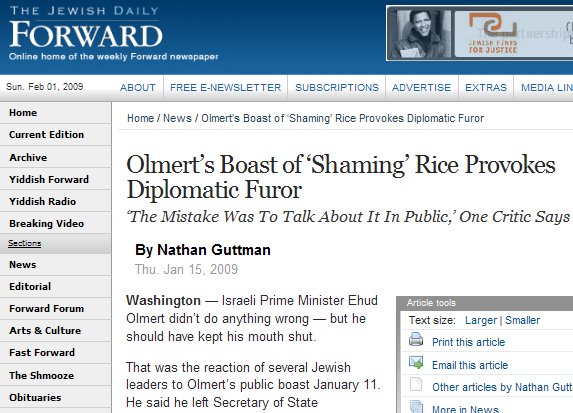
In all my years studying political science, I have never heard of a U.S. President being pulled off a podium because of a phone call. But that is exactly what happened. While the President was in the middle of giving a speech in Philadelpia, he was dragged off the podium because the Prime Minister of Israel said he wanted to talk with him. Bush then obediently did what Olmert demanded and immediately contacted Rice relaying Olmert’s orders to abstain from the resolution that she and White House had drafted. Here is the Jewish Daily Forward’s account of what happened.
It was in Ashkelon, in southern Israel, that Olmert gave a speech in which he said that on hearing of the draft that Rice had developed with her U.N. colleagues, he immediately called Bush, just minutes before the U.N. vote. He was told that Bush was giving a speech in Philadelphia and could not talk.
“I said, I don’t care; I have to talk to him,” Olmert told the crowd, which included reporters and TV cameras.
Bush, according to Olmert, was called off the podium and immediately agreed to look into the issue. “He gave an order to the secretary of state, and she did not vote in favor of it — a resolution she cooked up, phrased, organized and maneuvered for. She was left pretty shamed, and abstained on a resolution she arranged,” Olmert told the crowd.
Abe Foxman is head of the ADL, the Anti-Defamation League of B’nai B’rith, which supposedly opposes any sort of loyalty to one’s own heritage and freedom. However, the ADL spends most of its time defending from criticism the Israeli Apartheid State and Jewish supremacists around the world. Here is The Forward’s quote of Foxman:
“I have no problem with what Olmert did,” said Abraham Foxman, national director of the Anti-Defamation League. “I think the mistake was to talk about it in public.
Of course, Foxman has no probelm with Olmert ordering Bush around, but he doesn’t want the American people to know that the Israeli President has the power to interrupt the U.S. President in a speech and order him like an servile dog to do his bidding. And he sure doesn’t want the American people to know that Israeli Prime Minister also had the chutzpah to boast about it in a public speech.
This is one more sign that Jewish power is so impervious in America that it can literally get away with practically anything. Jewish extremists know that in the end the American political dog will only lick the hand that beats it.
With this kind of power it behooves us to know what Israel and the Jewish extremists want most. All would agree that there major objective is a war with Iran. May we do whatever necessary to prevent that catastrophe, an event that would have far more disastrous consequences for Iran, America and the world than did the War for Israel that America fought in Iraq.
Posted under:
General— @ 10:10 am
Olmert Boasts of Jewish Power — ADL says it’s true, but he should shut up about it!
by David Duke
A major Jewish newspaper has given graphic details of the incredible power Israel holds over the American government. It also shows the height of Jewish chutzpah in quoting the Israel Prime Minister’s speech in which he actually boasted of his power to order the U.S. President as one would a dog.
Secretary Rice had worked hard to put together a call for a cease fire and a “durable peace” by the U.N. Security Council which had the basic approval of the White House. At the last possible moment, the Council of Jewish Presidents and major Zionist organizations around the world decided that any sort of American approval of a cease fire might give people the idea that Israel was waging a murderous, relentless war against the Palestinian people themselves. In fact Israel did wage a terrorist war against the people of Gaza, killing 1400, maiming at least 5000, at least 2/3 of the victims being civilian men, women and children.
In all my years studying political science, I have never heard of a U.S. President being pulled off a podium because of a phone call. But that is exactly what happened. While the President was in the middle of giving a speech in Philadelpia, he was dragged off the podium because the Prime Minister of Israel said he wanted to talk with him. Bush then obediently did what Olmert demanded and immediately contacted Rice relaying Olmert’s orders to abstain from the resolution that she and White House had drafted. Here is the Jewish Daily Forward’s account of what happened.
It was in Ashkelon, in southern Israel, that Olmert gave a speech in which he said that on hearing of the draft that Rice had developed with her U.N. colleagues, he immediately called Bush, just minutes before the U.N. vote. He was told that Bush was giving a speech in Philadelphia and could not talk.
“I said, I don’t care; I have to talk to him,” Olmert told the crowd, which included reporters and TV cameras.
Bush, according to Olmert, was called off the podium and immediately agreed to look into the issue. “He gave an order to the secretary of state, and she did not vote in favor of it — a resolution she cooked up, phrased, organized and maneuvered for. She was left pretty shamed, and abstained on a resolution she arranged,” Olmert told the crowd.
Abe Foxman is head of the ADL, the Anti-Defamation League of B’nai B’rith, which supposedly opposes any sort of loyalty to one’s own heritage and freedom. However, the ADL spends most of its time defending from criticism the Israeli Apartheid State and Jewish supremacists around the world. Here is The Forward’s quote of Foxman:
“I have no problem with what Olmert did,” said Abraham Foxman, national director of the Anti-Defamation League. “I think the mistake was to talk about it in public.
Of course, Foxman has no probelm with Olmert ordering Bush around, but he doesn’t want the American people to know that the Israeli President has the power to interrupt the U.S. President in a speech and order him like an servile dog to do his bidding. And he sure doesn’t want the American people to know that Israeli Prime Minister also had the chutzpah to boast about it in a public speech.
This is one more sign that Jewish power is so impervious in America that it can literally get away with practically anything. Jewish extremists know that in the end the American political dog will only lick the hand that beats it.
With this kind of power it behooves us to know what Israel and the Jewish extremists want most. All would agree that there major objective is a war with Iran. May we do whatever necessary to prevent that catastrophe, an event that would have far more disastrous consequences for Iran, America and the world than did the War for Israel that America fought in Iraq.
Subscribe to:
Posts (Atom)


 Posts
Posts